

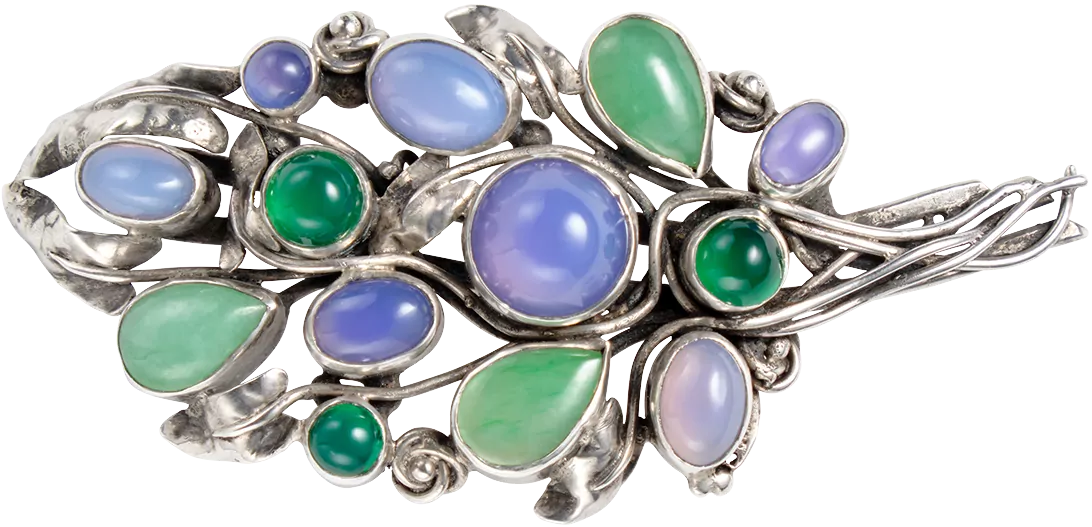
This brooch is by the Scottish silversmith Mary Thew who is known for her use of free-flowing silver wire and cabochon semi-precious gemstones. My brooch is made of silver, you can clearly see the trails of silver wire running through the piece. There is chalcedony, a type of quartz and jade all polished as cabochons.
Mary was born in Glasgow, Scotland in 1876 and studied at the Glasgow School of Art. In 1903 she married James Mursell Thew an engineer who dabbled in silversmithing as a hobby making jewellery for Mary. When James died leaving Mary with a young son and no means of support she decided to turn her hobby of making jewellery with her husband into a career. She took a short course, only four lessons, in jewellery making at the Glasgow School where she had studied previously, with the well-known Arts and Crafts jeweller Rhoda Wager. Mary joined the Greengate Close Coterie, a row of small cottages, linked by a cobbled path and a garden enclosed by trees. In the early 20th century the lane was a place where women could work, live, and create together. At various times the group included the illustrator Jessie M King and the writer Dorothy L Sayers. Mary was a member of the Glasgow Society of Lady Artists and in 1925 won the Society’s Lauder Award for a case of jewellery and she also exhibited in the Walker Art Gallery in Liverpool.
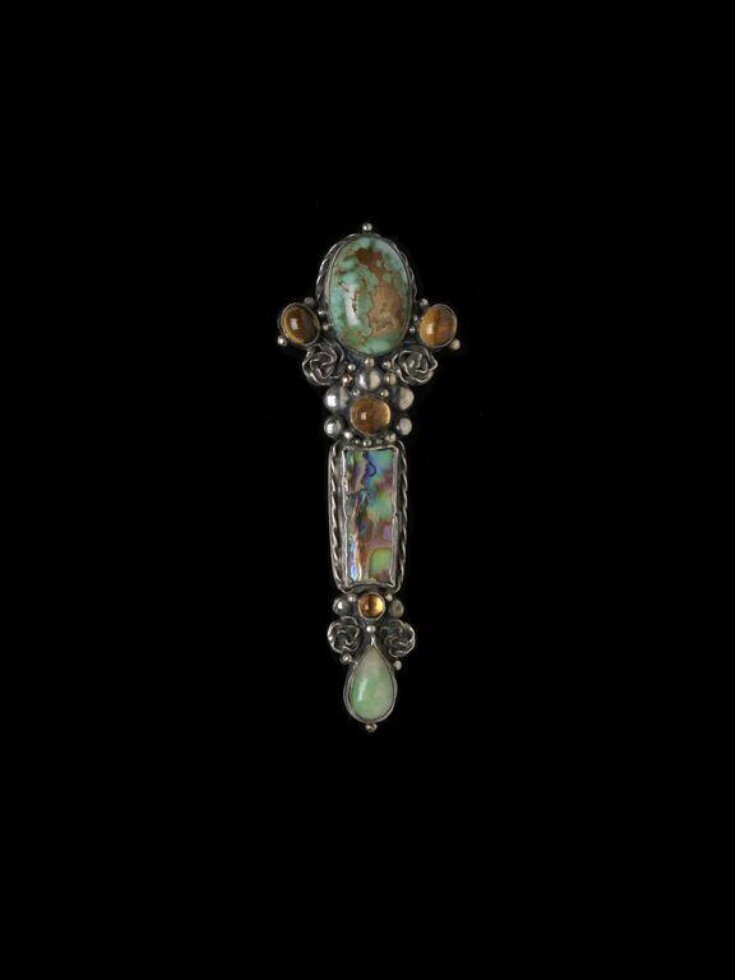
There is an example of Mary Thew’s jewellery in the V&A museum in London. The brooch is just over 8cm long, made of silver with abalone, turquoise, jade and citrine.
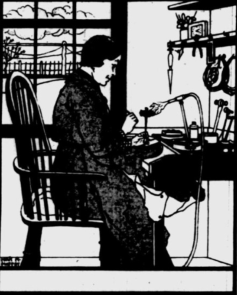
In 1939 Mary Thew was interviewed by Nan Muirhead Moffat for the Glasgow Herald, who described Mary’s workshop as “The desk is surmounted by shelves from which hang the numerous tools required for this complicated craft. The jeweller sits on a high Windsor chair … Within easy reach are her bottle of sperm oil and sulphuric acid, borax (used as a flux), a polishing lathe, a rolling machine, a vice, and a sandbag for hammering repousse. In the sketch, the artist is shown revolving a ring, on a wire ‘wig’, in a Bunsen-burner flame, while she uses foot bellows. While working, she always wears a leather apron and another is fixed under the desk to catch any jewels or pieces of metal which might be dropped.”
The journalist goes on to say “The artist has an instinct for creating a pleasing balance between space and decoration in her work, and she has a fine colour sense. She neither overloads with ornamentation nor allows her devotion to detail to detract from the general effect of her design.”
Mary Thew died in North Wales in 1953.
The Glasgow Society of Lady Artists was established in 1882 and flourished until 1971 when it was disbanded because of financial pressures. In 1975 it was revived as the Glasgow Society of Women Artists and is still going today.
Jade has been revered for millennia, in the Stone Age it was used for axe heads because of its toughness and ability to have sharp edges. The Mayans and Aztecs valued jade over gold where it was used in jewellery. But it is with China that jade is most associated, with a history going back 7,000 years. The Chinese character for jade 玉 is said to be one of the earliest written.